

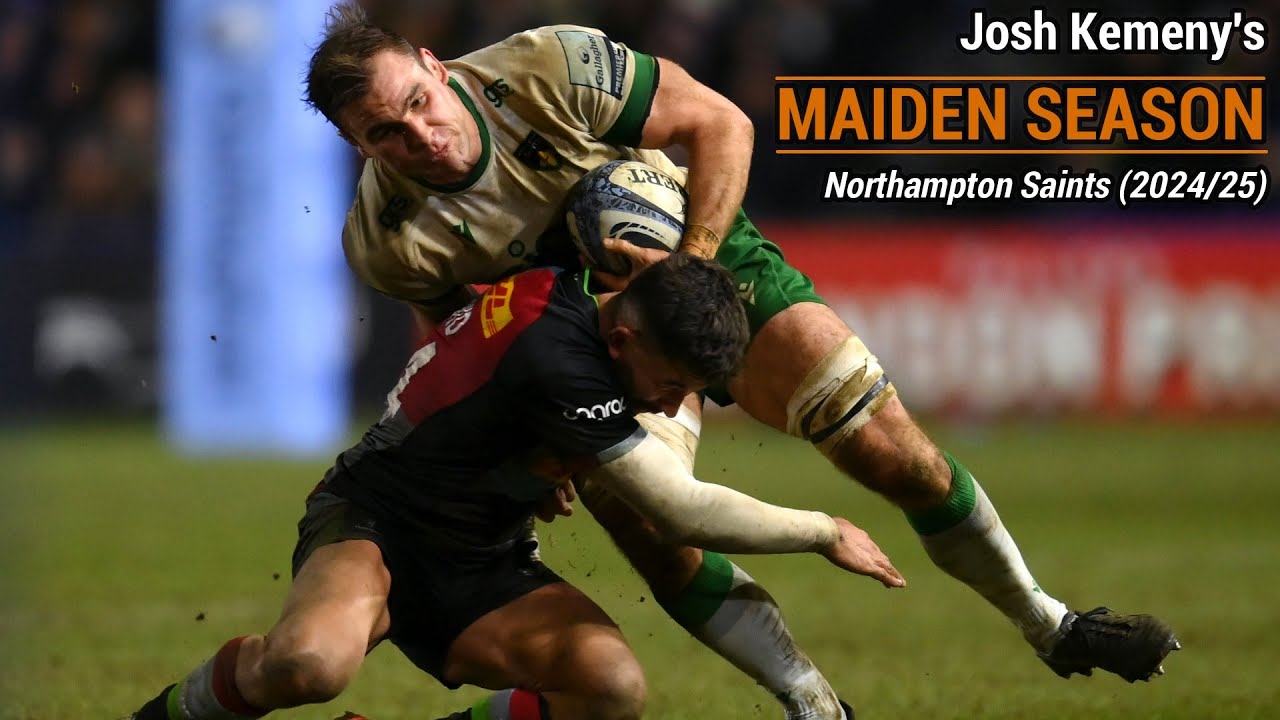
The Value Proposition: Why Kemeny Is Indispensable
Kemeny, the 27-year-old Australian import, arrived at Franklin’s Gardens in the summer of 2024 from the Melbourne Rebels, transitioning from Super Rugby to the rigors of the Premiership. His immediate assimilation into the physical environment of English rugby has been remarkable, demonstrating a rare combination of durability and finishing prowess.
The statistical evidence speaks volumes regarding his effectiveness. Since his arrival, Kemeny has featured in 28 matches for the Saints. Crucially, he started in 25 of those fixtures. In a position defined by high impact and subsequent rotation, this consistency underscores his technical reliability and fitness levels—qualities highly sought after in the Premiership calendar.
Furthermore, his offensive contributions have been significant for a third-row forward, crossing the try line eight times. Kemeny is not merely a breakdown specialist or defensive workhorse; he provides genuine attacking thrust, turning defensive pressures into offensive gains. This dual capability makes him a critical component of the Saints’ tactical structure.
The Negotiation Stalemate
Phil Dowson has been public about his desire to retain the Australian flanker, recognizing that securing established, high-performing talent is far more cost-effective and strategically sound than entering the open market. The current contract for Kemeny is set to expire next summer, meaning time is rapidly becoming a decisive factor for the club.
However, the negotiations have become protracted. While Dowson is actively pushing for a long-term commitment, Kemeny has yet to formally accept or decline the offer. This delay introduces an element of high-stakes uncertainty. In professional sport, when a player delays a contract decision, it rarely signals immediate agreement; rather, it suggests a careful calculation of market value and future trajectory.
There is an unspoken irony here: the more successful Kemeny is for the Saints, the more leverage he gains in contract negotiations, inevitably driving up the cost of retention for the club that fostered his Premiership success. The club’s urgency is inversely proportional to the player’s necessity to rush the decision.
Analyzing the Flanker’s Potential Motivations
Why would a key player delay a decision when he appears perfectly integrated into the club structure? Several factors likely contribute to Kemeny’s measured approach:
- Market Testing: A player of Kemeny’s calibre, having successfully proven himself outside of Super Rugby, will inevitably attract attention from rival Premiership clubs, and potentially lucrative offers from France (Top 14). By delaying, he allows his agent to gauge his true market worth.
- International Aspirations: While playing outside Australia can complicate Wallabies selection, Kemeny might be assessing whether remaining in the Premiership offers the best platform for future international recognition, or if a potential return to Super Rugby is necessary to cement a national squad spot.
- Salary Cap Management: For Northampton, retaining Kemeny must be balanced against the constraints of the salary cap. Negotiations often slow down when the requested salary approaches or exceeds the club’s established band for that position.
This calculated pause by Kemeny forces the Saints’ management into a difficult position: balancing the imperative to secure a vital asset quickly against the risk of overpaying in a moment of panic.
Conclusion: The Path Forward for Franklin’s Gardens
The outcome of the Josh Kemeny contract negotiation will serve as a crucial test of Northampton’s recruitment and retention strategy. Losing a player who has proven his ability to dominate the third line—a position critical for parity in the Premiership—would necessitate an expensive and risky search for an equivalent replacement.
As the clock ticks toward the next transfer window, Phil Dowson and his team remain committed to securing the flanker’s signature. Until Kemeny makes his final decision, the Saints are left navigating the delicate economics and psychology of modern rugby contracts, hoping that performance and club loyalty outweigh the allure of rival offers.
 Rupert Caldwell