

The dust has barely settled on Lando Norris’s triumphant 2025 World Championship campaign—a season finale that, by all metrics, delivered on its promise of nail-biting, competitive racing. Yet, in the relentless machine that is Formula 1, introspection quickly gives way to preparation. The 2026 season is not merely a sequential renewal of the calendar; it represents a fundamental technical and structural reset.
Teams have endured a remarkably brief winter hiatus, scrambling to adapt to the monumental rule changes set to debut. This year promises both complexity and opportunity, presenting a blank slate that ensures the 2026 grid will bear little resemblance, mechanically speaking, to its predecessors. Fans anticipating stabilization will be met instead with revolution, accompanied by the largest expansion the grid has seen in decades.
Key Takeaways for F1 2026:
- New technical regulations fundamentally alter car design and power unit dynamics.
- The grid expands to 11 teams (22 drivers) with the introduction of Cadillac.
- Audi officially enters the championship, taking over the existing Sauber structure.
- The race calendar features 24 rounds, including a new stop in Madrid and six Sprint weekends.
The New Calculus: Grid Expansion and Power Unit Shifts
The most immediate visible change will be the sight of 22 cars lining up on the grid. After years of discussion, the roster expands to 11 teams. This monumental addition is thanks to Cadillac, marking a significant entry of American motorsport heritage into the pinnacle of racing. While the specific impact on logistics and circuit capacity remains a topic for discussion—a point we address with appropriate technical skepticism—the infusion of new talent and resources is undeniable.
Furthermore, the long-anticipated integration of Audi is complete, as the German powerhouse assumes control of the former Sauber team. These major manufacturer investments underscore the appeal of the new regulatory cycle, particularly concerning the revised power unit requirements designed to increase electrical output and decrease the reliance on traditional combustion engines.
A new era of car design means the pecking order is entirely unknown. Success in 2026 will be dictated not by marginal gains on existing platforms, but by correctly interpreting the regulatory language—a task that has often separated champions from the also-rans in past rule upheavals.
Pre-Season Preparations: Where the True Order Emerges
Given the regulatory shake-up, pre-season testing gains unprecedented importance. Teams face the challenge of validating entirely new concepts under competitive conditions, meaning every lap is scrutinized for reliability and performance data.
The 2026 testing schedule is divided into two distinct phases:
Phase I: Closed-Doors Data Collection
In a move agreed upon by the teams outside of formal FIA organization, four days of intensive, private running are scheduled in Spain.
- Dates: January 26–30
- Location: Circuit de Barcelona-Catalunya
- Note: This highly controlled environment allows teams to conduct fundamental shakedowns and correlation runs away from public scrutiny. Expect zero official timing data to be released—only cryptic social media posts offering vague optimism.
Phase II: The Public Debut
The traditional venue for the public launch, the Bahrain International Circuit, hosts six crucial days of running, split over two weeks. This is the first opportunity for fans and rivals alike to gauge the true speed potential of the “New Era” machines.
- First Session: February 11–13 (Bahrain)
- Second Session: February 18–20 (Bahrain)
- Broadcast Status: Full television coverage, providing the first glimpse of the 2026 competitive landscape.
The Global Gauntlet: Formula 1 2026 Race Calendar
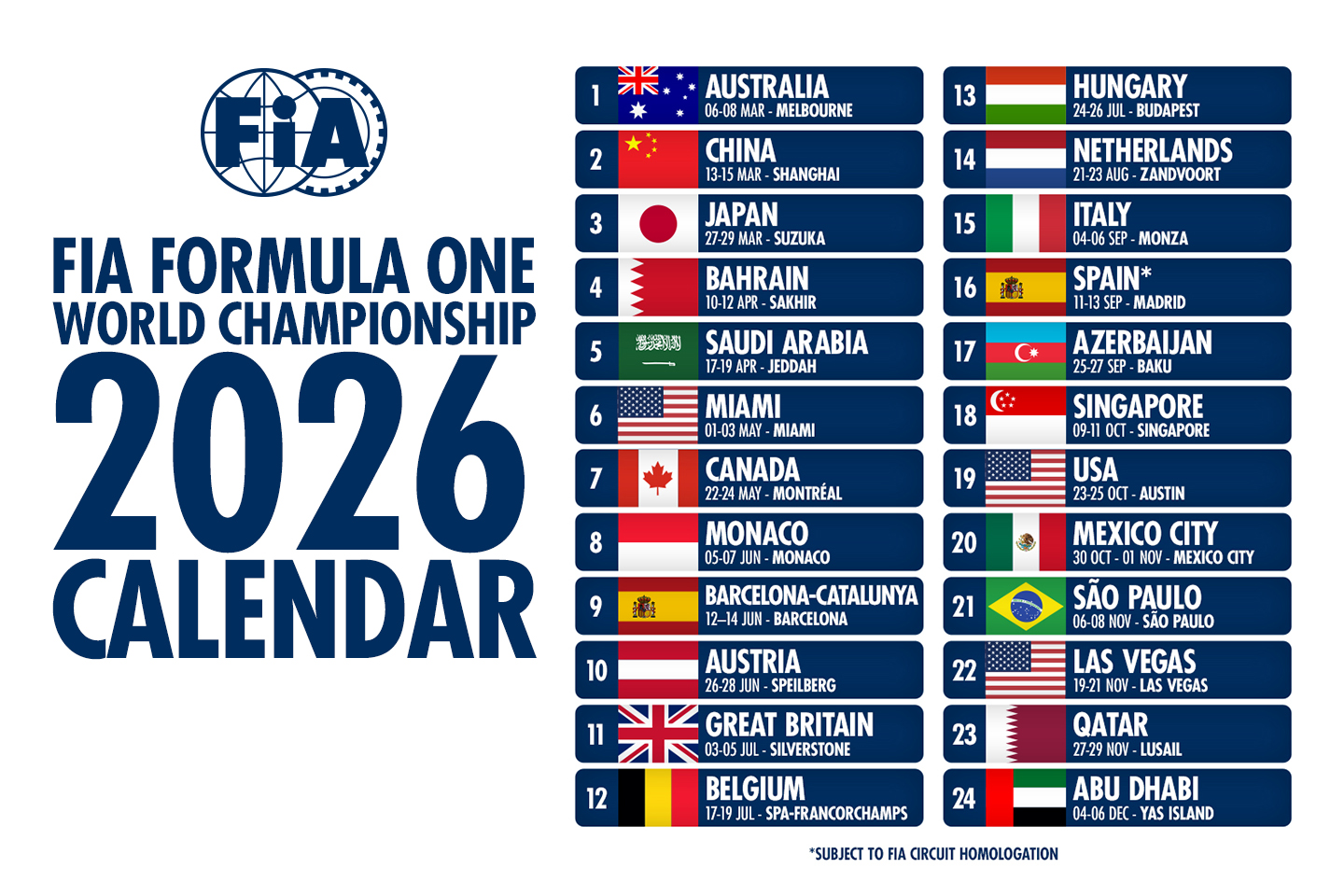
The 2026 season confirms the sport`s global expansion with a packed 24-race schedule. The calendar balances traditional European circuits with high-profile stops in North America and Asia, demanding extreme logistical efficiency from all 11 competing teams. The season kicks off earlier than in recent years, leaving minimal time between final testing in Bahrain and the lights-out moment in Australia.
Of particular note are the six scheduled Sprint Weekends, adding further opportunity for points and maximizing track action. Spain also welcomes a new venue, swapping the familiar Catalunyan circuit for the streets of Madrid later in the year.
The Schedule: Rounds 1 to 13 (March – July)
- Round 1: March 6–8: Australian Grand Prix, Melbourne
- Round 2: March 13–15: Chinese Grand Prix, Shanghai (Sprint Weekend)
- Round 3: March 27–29: Japanese Grand Prix, Suzuka
- Round 4: April 10–12: Bahrain Grand Prix, Sakhir
- Round 5: April 17–19: Saudi Arabian Grand Prix, Jeddah
- Round 6: May 1–3: Miami Grand Prix, Miami (Sprint Weekend)
- Round 7: May 22–24: Canadian Grand Prix, Montreal (Sprint Weekend)
- Round 8: June 5–7: Monaco Grand Prix, Monaco
- Round 9: June 12–14: Barcelona-Catalunya Grand Prix, Barcelona
- Round 10: June 26–28: Austrian Grand Prix, Spielberg
- Round 11: July 3–5: British Grand Prix, Silverstone (Sprint Weekend)
- Round 12: July 17–19: Belgian Grand Prix, Spa-Francorchamps
- Round 13: July 24–26: Hungarian Grand Prix, Budapest
Following Hungary, the mandatory F1 Summer Break offers a brief respite before the decisive run-in.
The Schedule: Rounds 14 to 24 (August – December)
- Round 14: August 21–23: Dutch Grand Prix, Zandvoort (Sprint Weekend)
- Round 15: September 4–6: Italian Grand Prix, Monza
- Round 16: September 12–14: Spanish Grand Prix, Madrid (New Venue)
- Round 17: September 24–26: Azerbaijan Grand Prix, Baku*
- Round 18: October 9–11: Singapore Grand Prix, Marina Bay (Sprint Weekend)
- Round 19: October 23–25: United States Grand Prix, Texas
- Round 20: Oct. 30–Nov. 1: Mexico City Grand Prix
- Round 21: November 6–8: Sao Paulo Grand Prix
- Round 22: November 19–21: Las Vegas Grand Prix
- Round 23: November 27–29: Qatar Grand Prix, Lusail
- Round 24: December 4–6: Abu Dhabi Grand Prix, Yas Marina
*Note: The Azerbaijan Grand Prix maintains a Saturday race slot to accommodate a national day observance.
Conclusion: Anticipation vs. Reality
The 2026 Formula 1 season is a high-stakes gamble. The combination of fundamental aerodynamic and power unit regulation changes, coupled with the introduction of two highly motivated factory operations (Audi and Cadillac), guarantees that the equilibrium established in recent years is about to be violently disrupted. Whether these changes lead to the intended parity or merely usher in a new era of dominance by the one team that nailed the regulatory interpretation remains the most compelling question of the year.
For fans, the wait is agonizingly short. The spectacle begins in earnest in January, well before the first official race in Melbourne. The race is on, not just on the track, but in the factories and wind tunnels, to master the new ruleset and claim the ultimate technical advantage.
 Rupert Caldwell