

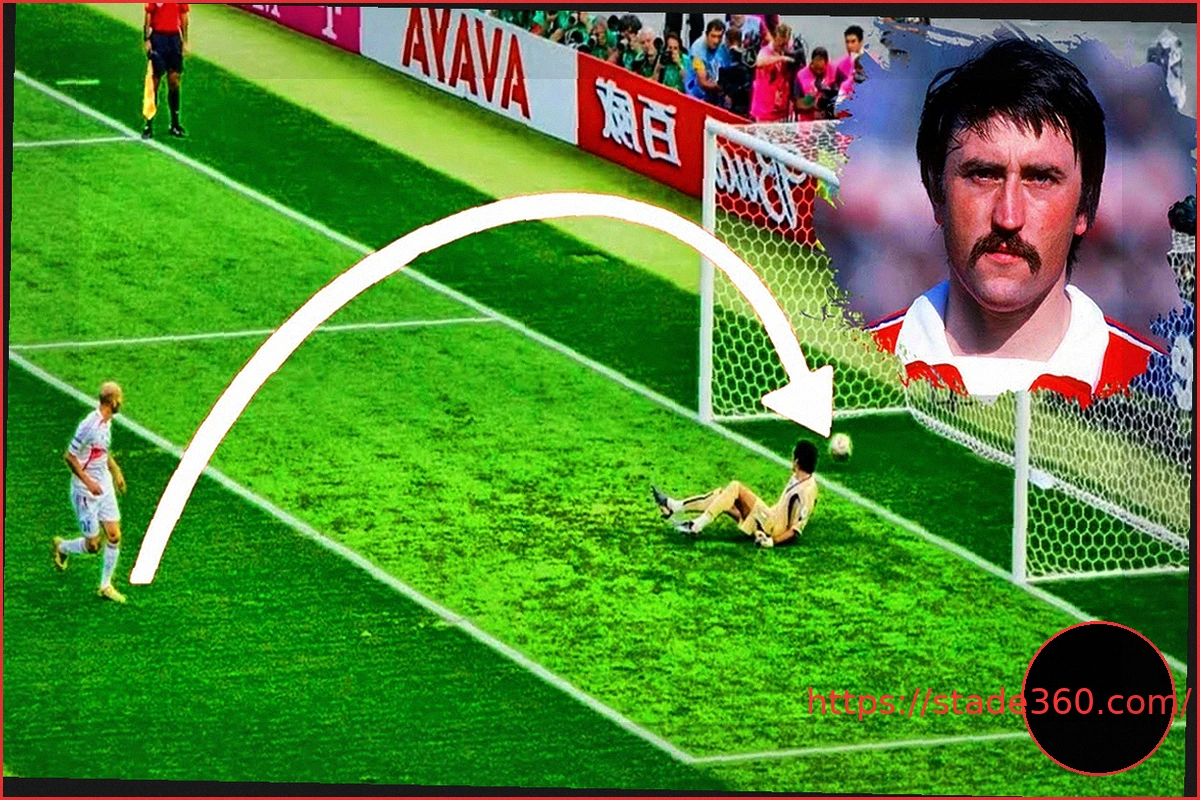
Among football’s most captivating spectacles, the Panenka penalty stands out, blending exquisite nerve with sheer artistry. This daring skill, a mix of refined technique, sharp psychology, and audacious showmanship, has the power to either embarrass goalkeepers and thrill supporters or, if misexecuted, lead to severe repercussions.
This article delves into the essence of the Panenka: its definition, its historical roots, and its prominent appearances within the Premier League.
The Origins of the Panenka
The Panenka penalty derives its moniker from Antonín Panenka, the Czech footballer who unveiled this distinctive technique during the climactic UEFA European Championship Final in 1976.
Representing Czechoslovakia in a high-stakes penalty shootout against West Germany, Panenka approached the spot. Instead of powering the ball towards a corner, he executed a delicate chip directly through the center, precisely as opposing goalkeeper Sepp Maier committed to a dive. The ball gracefully arced into the goal, securing the win and etching itself into football folklore as an unforgettable instant.
This innovative concept wasn’t an overnight revelation. Reports suggest Panenka dedicated numerous post-training sessions to practicing penalties. He observed that goalkeepers frequently anticipated a shot by diving prematurely to one side. His ingenious counter-strategy involved maintaining composure and delicately lofting the ball centrally, thus capitalizing on the keeper’s early commitment.
How the Panenka Works
Fundamentally, the Panenka appears deceptively straightforward. Rather than employing brute force, the penalty taker subtly chips the ball into the net’s central area. The effectiveness of this method hinges entirely on keen anticipation and unwavering composure.
Essential components for its successful execution encompass:
- Goalkeeper Analysis: A prerequisite is accurately predicting the goalkeeper’s movement, as most tend to dive either left or right.
- Precise Timing: The chip requires impeccable timing and just the right amount of loft.
- Unwavering Self-Belief: Any moment of doubt or hesitation almost invariably spells doom for the attempt.
Its distinctive nature lies less in its physical demands and more in its profound psychological aspect. The player essentially gambles on the goalkeeper committing to a dive, demonstrating absolute conviction in that assumption.
Why Players Attempt a Panenka
The Panenka is frequently regarded as the pinnacle of self-assurance in football. Its successful execution can dramatically alter game momentum, undermine the morale of opposing teams, and inspire teammates.
Numerous factors contribute to players opting for this audacious technique:
Psychological Advantage
By capitalizing on the goalkeeper’s inherent impulse to dive, the penalty-taker secures a distinct advantage. As articulated by former stopper Petr Cech, goalkeepers frequently experience immense pressure to make a move rather than remain static, rendering them susceptible to such a ploy.
Element of Surprise
Given its relative infrequency, a Panenka possesses the capacity to take even seasoned goalkeepers completely by surprise.
High Stakes Drama
This technique is occasionally reserved by players for crucial, high-stakes scenarios, where its emotional resonance is maximized—a strategy that, however, also escalates the inherent risks.
The Panenka in the Premier League
Over the years, the Premier League has witnessed numerous Panenka attempts, met with mixed fortunes.
A recent notable example occurred when Cole Palmer deftly chipped his penalty during Chelsea FC’s thrilling victory over Tottenham Hotspur. In a moment brimming with tension, Palmer’s choice to aim centrally demonstrated extraordinary self-possession, coupled with undeniable panache.
Previous instances feature:
- Thierry Henry, renowned for his iconic chipped penalty for Arsenal FC in 2003.
- Alexis Sánchez, whose Panenka in stoppage time dramatically clinched a victory against Burnley.
- Eden Hazard, who deployed this technique on several occasions throughout his career, including in various cup tournaments.
Such instances underscore the Panenka’s evolution into a recognized, albeit perilous, weapon within a footballer’s repertoire.
The Risks: When It Goes Wrong
Despite its potential for brilliance, the Panenka is laden with considerable hazards. Should the goalkeeper remain stationary, or if the chip is executed without adequate precision, the outcome is frequently mortifying.
A particularly infamous Premier League example involved Ademola Lookman, whose ill-judged attempt for Fulham FC was effortlessly thwarted, thereby depriving his team of a vital result.
Likewise, Sergio Agüero’s Panenka was saved during a pivotal Manchester City fixture, attracting extensive disapproval.
Even elite athletes are not exempt from its potential pitfalls. The margin for error is exceptionally narrow: an excessive amount of power transforms it into a standard shot, while insufficient force renders it an effortless save.
Memorable Panenkas Beyond England
Although the Premier League has incorporated this technique, several of the most iconic Panenkas have unfolded on the international stage.
- Zinedine Zidane delivered a spectacular chipped penalty in the 2006 FIFA World Cup Final.
- Andrea Pirlo demonstrated masterful execution of the technique during Euro 2012.
- Footballing luminaries such as Lionel Messi and Cristiano Ronaldo have also explored this particular skill.
Such instances have undeniably solidified the Panenka’s reputation as one of football’s truly emblematic skills.
A Skill That Defines Confidence
In essence, the Panenka transcends the simple act of scoring a penalty kick. It serves as a profound indicator of a player’s mental fortitude—their inclination to embrace risks, exhibit creative flair, and execute under intense pressure.
Within the meticulously structured and fiercely competitive environment of the Premier League, where outcomes are decided by the narrowest of margins, attempting a Panenka constitutes a audacious statement. Success yields indelible moments, while failure often results in a cautionary narrative.
Irrespective of the outcome, one fact remains constant: the Panenka will perpetually rank among football’s most debated and exhilarating techniques.