

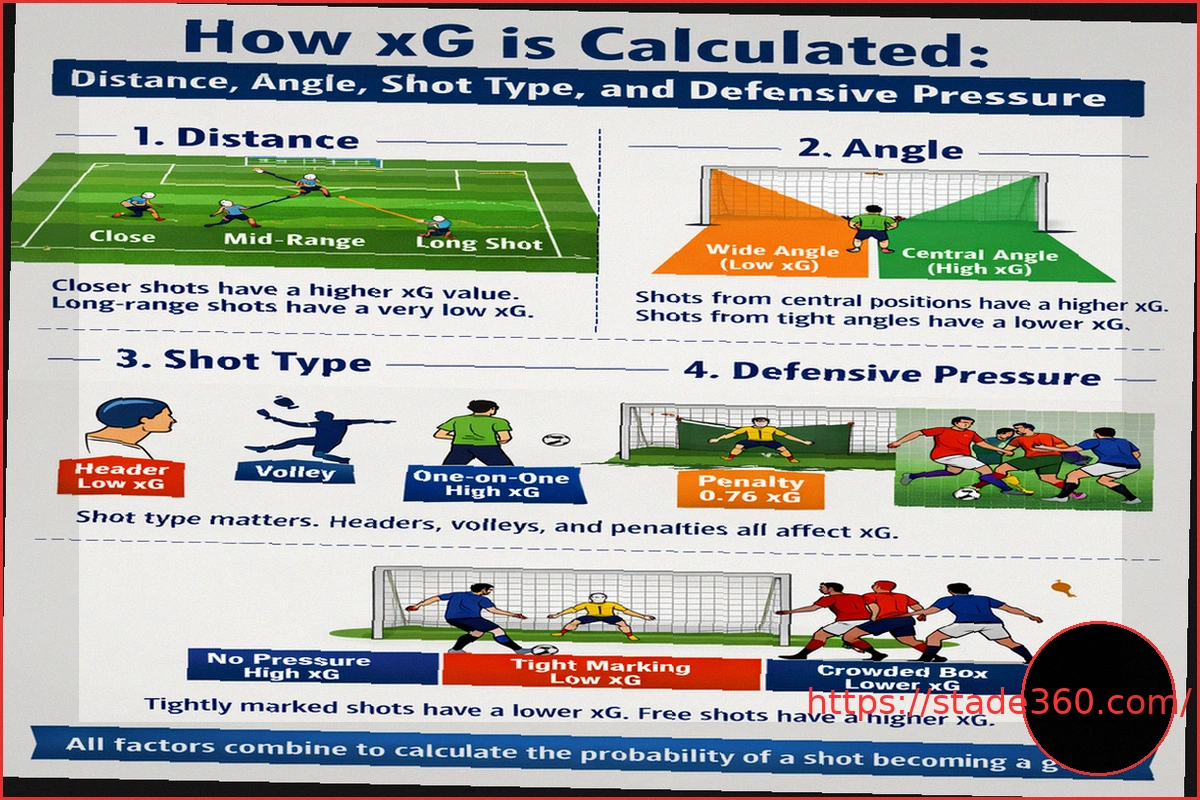
In contemporary football, statistics have evolved beyond mere numbers, becoming essential instruments for comprehending the game at a granular level. One metric that has fundamentally reshaped how analysts, coaches, and enthusiasts evaluate attacking performance is Expected Goals (xG). Unlike traditional goal tallies, xG quantifies the caliber of goal-scoring opportunities a team or player generates, offering a more complete portrayal of their offensive output. But what exactly goes into this calculation? Let’s delve into the crucial elements: distance from goal, angle to the net, the specific shot type, and the degree of defensive pressure.
What is Expected Goals (xG)?
At its core, xG represents the probability that a given shot will result in a goal. Each shot is assigned a numerical value ranging from 0 to 1, where 0 signifies an almost impossible chance and 1 indicates a near certainty of scoring. For example, a penalty kick typically carries an xG between 0.76 and 0.80, reflecting its high likelihood of success, while a speculative long-range attempt from outside the box might have an xG as low as 0.02. Summing a team’s xG over a match or an entire season can reveal whether they consistently create high-quality chances or are largely relying on fortunate outcomes to score.
1. Distance from Goal
One of the most significant variables in determining xG is the distance of the shot from the goal. Simply put, the closer a player is to the target, the higher the probability of converting the chance. Shots originating from within the six-yard box naturally possess a considerably higher likelihood of becoming a goal compared to attempts taken from 25 or 30 yards out.
Sophisticated models don’t just measure a straight-line distance; they often integrate factors such as goalkeeper positioning and the player’s angle of approach. For instance, a shot taken from 12 yards with the goalkeeper slightly out of position is deemed more threatening than a similar effort with the keeper perfectly placed. Distance serves as a foundational component in nearly all xG models due to its direct impact on scoring probability.
2. Angle to Goal
The angle at which a shot is taken relative to the goal is another critical determinant. Shots struck from a narrow angle near the goal line are inherently less likely to find the net than central shots, even if the distance from goal is comparable. This is primarily because the visible area of the goal to the shooter is reduced, thereby increasing the goalkeeper’s chances of making a save.
Some xG algorithms incorporate the concept of a shooting corridor, which simultaneously considers both the angle and distance. For example, a 15-yard shot from a central position will have a much higher xG than a 15-yard shot taken from a sharp angle close to the touchline. By accounting for the angle, analysts can distinguish between seemingly similar opportunities that possess vastly different probabilities of success.
3. Shot Type
Not all attempts on goal are created equal. The specific type of shot — whether it’s a header, a volley, a simple tap-in, or a powerful long-range effort — significantly influences its xG value.
- Headers generally have a lower xG than shots struck with the feet, even from close proximity, as headers are typically more challenging to direct with precision.
- Tap-ins directly in front of an open goal frequently register an xG above 0.7, reflecting their high conversion rate.
- Long-range efforts from a distance usually have a much lower xG, often below 0.05, unless they involve exceptional skill or catch the goalkeeper off guard.
Shot type also considers a player’s body orientation and control, as these elements can significantly affect the likelihood of scoring. Advanced tracking technologies can even discern whether a shot was taken under controlled circumstances or while the player was in motion, further refining xG calculations.
4. Defensive Pressure
A crucial, though often underestimated, factor in xG calculation is defensive pressure. Even a shot from close range can become exceptionally difficult if the shooter is closely marked or under intense pressure from an opposing player. Modern xG models account for the presence of defenders, their proximity to the shooter, and whether the attempt is made into a crowded penalty area.
For instance, a shot from inside the box with a defender actively sliding in to block it might see its xG diminish from 0.6 to 0.3. Conversely, a shot taken in a congested box but with ample space for the shooter to aim may maintain a higher xG. By integrating defensive context, xG can more accurately reflect the true quality of a scoring opportunity rather than just its spatial location.
Additional Variables
Beyond distance, angle, shot type, and defensive pressure, some cutting-edge xG models incorporate other elements to enhance their accuracy:
- Assist type: Whether the chance originated from a through ball, a cross, or a set piece.
- Body part used: Right foot, left foot, or head.
- Game situation: Opportunities created during open play versus those from set pieces.
- Match context: Factors like player fatigue or the tempo of the game, although these are less commonly integrated.
These supplementary variables contribute to a more nuanced comprehension of chance quality, providing managers and analysts with a clearer insight into performance.
Why xG Matters
xG enables teams to assess more than just the final scoreline. A team might lose a match 2-1 but register an xG of 3.0, suggesting they created enough high-quality chances that, on average, should have resulted in a victory. Conversely, a team winning 1-0 with an xG of 0.5 might have been rather fortunate. Over the course of a season, xG can predict underlying performance trends more reliably than raw goal counts, assisting clubs in making informed strategic decisions regarding tactics, player recruitment, and talent development.
Conclusion
Expected Goals has revolutionized football analytics, offering a scientific framework for measuring offensive quality. By meticulously factoring in distance, angle, shot type, and defensive pressure, xG models translate complex in-game scenarios into a clear, quantifiable metric. While not an infallible measure and best considered alongside other statistics, xG remains a potent tool for managers, analysts, and fans striving to grasp the genuine dynamics of goal-scoring opportunities.
As tracking technology continues to advance, xG models are becoming increasingly sophisticated, delivering deeper insights into player efficiency, tactical effectiveness, and even potential transfer targets. For anyone seriously engaged with football analytics, understanding the intricacies of xG calculation is an essential first step toward appreciating the subtle complexities of the beautiful game.